
Nomad blackboard: Types of plants
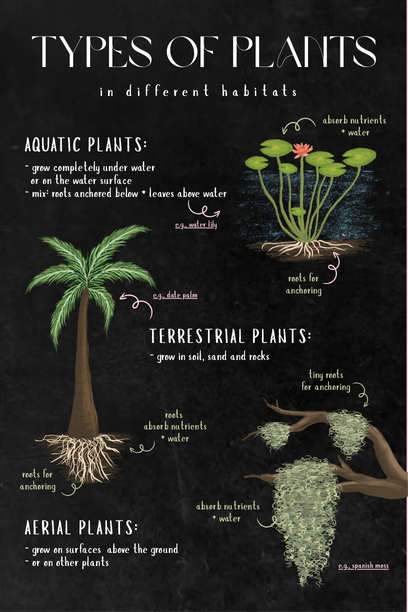
Plants grow in a variety of habitats. Terrestrial plants get nutrients from the soil, aquatic plants from the water, and aerial plants from the air. Let’s get into it.
Terrestrial plants
Terrestrial plants grow in soil and also in dry habitats like sand or rocks. Their roots are often extensive, helping them anchor firmly and reach water deep in the soil during dry periods. Besides their main source in the soil, terrestrial plants also take nutrients from rain, organic material, and the soil surface. They provide habitats for insects, birds, and other wildlife and help to stabilize the soil.
Aquatic plants
Aquatic plants grow underwater, on the water surface, or anchored in the bottom with leaves or stems above the water. Their roots are thin and flexible, serving mostly to anchor the plant in mud or underwater soil. Most water and nutrients are absorbed through the stems and leaves, allowing the plant to thrive even when soil nutrients are limited. They provide habitats for insects, fish, other wildlife and help to keep the water clean.
Aerial plants
Aerial plants grow on surfaces above the ground or on other plants. Their roots mainly anchor them, while the leaves absorb water and nutrients from the air, allowing them to live completely without soil. They rely almost entirely on their leaves to capture water and nutrients through tiny structures called trichomes, using their roots only for anchoring. They are particularly common near the coast, where the humid conditions help them thrive. Furthermore, they create microhabitats for insects and small animals and contribute to nutrient cycles by capturing water and organic particles from the air.
Epiphytes
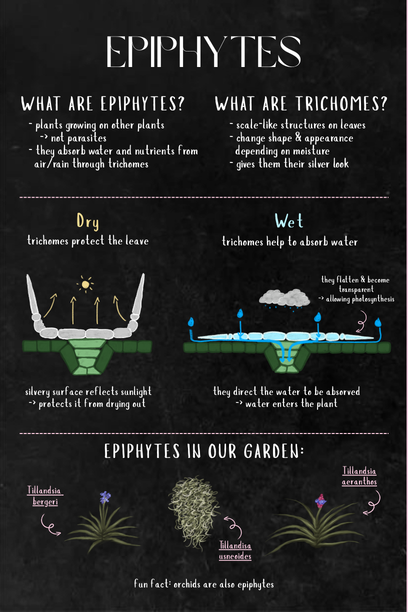
Epiphytes are organisms that grow on top of other organisms. Aerial plants can be considered epiphytes when they grow on top of trees or tall bushes. They are not parasites because they don’t have negative effects on the plant they stay on.
In the garden, you can see three main species: Tillandsia bergeri, T. aeranthos and T. usneoides. They are members of the Bromeliaceae family that originate from South America and prefer moderate humidity and exposure to sunlight.
- Tillandsia bergeri forms dense rosettes, produces many offsets, and develops violet-blue flowers in autumn. Its strong colony formation makes it a hardy and popular ornamental air plant.
- Tillandsia aeranthosalso blooms in spring, with blue and red flowers. It thrives at sea level and forms colonies quickly.
- Tillandsia usneoides is the most common bromeliad. It produces small, greenish-yellow flowers and reproduces mainly vegetatively. Formerly used as stuffing material, it is now valued for decorative purposes and by birds as nesting material.
Trichomes
Trichomes are scale-like structures that cover the leaves of aerial plants, such as Tillandsia. They play an essential role in water regulation.
When dry, trichomes stand upright and appear silvery. In this state, they reflect sunlight and help protect the plant from overheating and water loss.
When exposed to moisture from rain, mist or humid air, they absorb water and flatten against the leaf surface. As they fill with water, they become more transparent, allowing more light to reach the leaf and support photosynthesis. The collected water then moves downward into the leaf tissue, where it is absorbed by living cells.
Information sources
https://www.egoiplants.com/tillandsia-bergeri/
https://solotillandsias.com/producto/bergeri/
https://solotillandsias.com/producto/aeranthos/
https://colombia.inaturalist.org/taxa/49569-Tillandsia-usneoides
https://en.wikipedia.org/wiki/Spanish_moss
https://en.wikipedia.org/wiki/Tillandsia
https://www.argentinat.org/taxa/370737-Tillandsia-aeranthos
https://ca.wikipedia.org/wiki/Tillandsia_bergeri
https://www.lloydgodman.net/Photosynthesis/PHoToS/Tiians/Berg.htm
https://celuzag.mx/2018/12/28/tillandsia-usneoides-o-musgo-espanol-heno/
https://nativas.lanacion.com.ar/plantas/planta/Tillandsia_aer%C3%A4nthos?ecoregion=Selva_Paranaense,Delta_e_Islas_del_Paran%C3%A1,Pampean,Chaco_H%C3%BAmedo,Esteros_del_Iber%C3%A1,Campos_y_Malezales,Altos_Andes,Chaco_Seco,Espinal,Espinal_Norte,Espinal_Sur,Bosques_Patag%C3%B3nicos,Bosques&lugar=Argentina&filtros=&search=
https://www.mpgcamb.com/wp-content/uploads/2024/12/Plant-Systematics-An-Integrated-Approach-Gurcharan-Singh-3-Edition.pdf
https://en.wikipedia.org/wiki/Terrestrial_plant
https://en.wikipedia.org/wiki/Epiphyte
https://en.wikipedia.org/wiki/Aquatic_plant
https://www.brainkart.com/article/Trichomes—The-leaf_19089/
https://www.sciencedirect.com/science/article/abs/pii/S0367253009000954
https://www.sciencedirect.com/topics/agricultural-and-biological-sciences/programmed-cell-death
